
From 1 July 2026, the EU will end the old customs duty exemption for low-value parcels and replace it with a temporary EUR 3 customs duty per item for many parcels valued at up to EUR 150. This will affect UK businesses sending goods into the EU, especially those selling directly to consumers, using couriers, or relying on fast, low-value parcel shipping.


The EU says the old low-value duty relief no longer makes sense because customs data is now digital and available for all imports, even low-value ones. In plain English, the EU is saying the old system was too easy to exploit and too hard to manage fairly across modern e-commerce flows. The change is also meant to improve product safety checks and make it harder for non-compliant goods to slip through customs.
The main change is simple. If goods are sold in a qualifying low-value parcel from outside the EU to a customer in the EU, the parcel may now attract a fixed EUR 3 customs duty per item, rather than the old exemption. The rule applies to consignments with an intrinsic value up to EUR 150 and runs from 1 July 2026 to 1 July 2028, unless the EU extends it. This is not a VAT change. The existing VAT schemes stay in place, including IOSS, Special Arrangements and the standard VAT procedure.
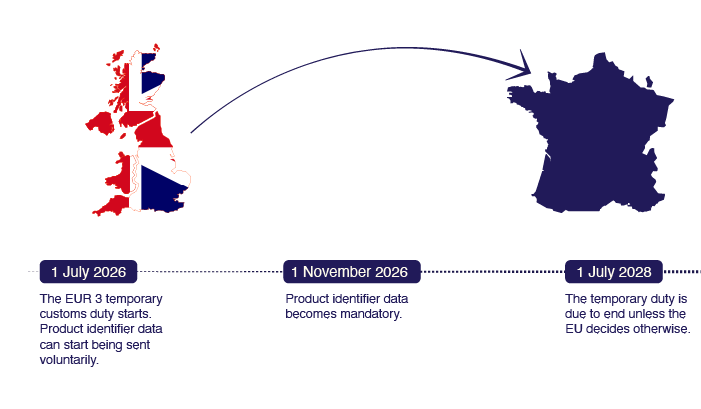
Here are the dates businesses should plan around:
• 1 July 2026. The EUR 3 temporary customs duty starts.
• 1 July 2026. Product identifier data can start being sent voluntarily.
• 1 November 2026. Product identifier data becomes mandatory.
• 1 July 2028. The temporary duty is due to end unless the EU decides otherwise.
This is the bit that is still a bit confusing, even in the official guidance, so here is the simplest way to think about it. Distance selling is when a business sells goods from outside the EU to a customer in the EU, and the seller, or someone acting on the seller's behalf, arranges or sends the transport. That means it usually covers normal online orders shipped from the UK to EU customers. It can also cover situations where the seller indirectly helps arrange delivery, even if another company physically moves the parcel. If the customer completely organises the transport themselves without the seller being involved, that may fall outside the distance sale rules.
If you ship low-value goods into the EU, this is now a practical shipping issue as much as a customs issue. You need to know how your goods are declared, who is named as the declarant, what data your courier needs, and how your VAT setup fits into the new duty rules. If your product data is weak, your declarations are likely to become slower and more error prone.
For us at Flow Group, this matters directly because we ship parcels into the EU ourselves through modernbookbinders.co.uk, and we also support clients who will be affected. That means this is not a theoretical compliance update. It affects our shipments, our customers, and the advice we give businesses sending low-value parcels into Europe.
The duty is a fixed EUR 3 per item, not a percentage of the parcel value. That matters because a parcel containing several items may incur multiple charges depending on how it is declared. The guidance also says item grouping is not allowed where the temporary duty applies, which means accurate item-level data becomes even more important.

The responsibility sits with the declarant, which is usually the IOSS holder, the Special Arrangements user, their indirect representative, or another eligible customs representative. In most business setups, that means the sender, platform, carrier, or customs agent must ensure the duty is handled correctly. The consumer becomes a declarant only in very limited cases where the member state makes a free online process for individuals.
One thing businesses may miss is the return rule. If goods are returned after release, the customs declaration for those goods cannot simply be invalidated to reverse the duty. That means the EUR 3 duty will not automatically be refunded or remitted through that route. So, if you sell low-value goods into the EU, your returns policy and customer service process may need a review.
The EU is also rolling out new product identifier data, which will be voluntary from 1 July 2026 and mandatory from 1 November 2026. This is designed to help customs spot non-compliant goods more easily and improve traceability through the supply chain.
The guidance introduces three useful types of product identifiers. One is the merchant product identifier, one is the non-standardised manufacturer product identifier, and one is the standardised manufacturer product identifier. If your systems or suppliers do not already hold this information cleanly, now is the time to fix that.
Royal Mail “Royal Mail and Parcelforce have already told customers that changes are being made to shipping platforms from 26 June 2026, ahead of the 1 July implementation. Their message is clear: businesses may need to provide more accurate shipment data at booking, and getting that data right will help avoid delays and extra handling.”
DHL is also actively warning customers about the EU customs reform and is telling shippers to prepare for the end of the EUR 150 duty-free threshold, improve shipment data, and review customs processes now. DHL’s guidance is especially useful because it concentrates on practical shipping steps rather than just the law.
ParcelBroker explains the change in plain English and highlighting the new data requirements and the need for UK businesses to prepare for the July 2026 changes. Taken together, these providers are all making the same point. If you ship into the EU, customs data quality matters much more now than it did before.
Disclaimer: "All product names, logos, and brands are property of their respective owners. Use of these names and logos does not imply endorsement or affiliation."
1. Check which of your products are commonly sold into the EU under EUR 150.
2. Review whether you use IOSS, Special Arrangements or standard VAT.
3. Make sure each product has a clean product identifier in your system.
4. Speak to your courier or customs broker about how they will handle the new duty.
5. Review your returns process so your team knows what happens if a parcel comes back.
For us at Flow Group, this change matters in two ways. First, it affects our EU shipments through modernbookbinders.co.uk, so we need to ensure our export data, product identifiers, and customs declarations are correct from day one. Second, it affects clients who send low-value goods to the EU and will need practical support to adjust quickly.
This is exactly the kind of regulatory change that requires compliance, operations, and shipping teams to work together. The businesses that understand the rules early will be better.
This article is based on the European Commission guidance Importation and exportation of low value consignments the EUR 3 temporary customs duty Guidance for Member States and Trade Version of 2 June 2026 and the UK government’s EU UCC reforms guidance for businesses.
If you send parcels into the EU, now is the time to review your customs process, product data and courier setup. At Flow Group, we are already adapting our own shipping processes and helping clients prepare for the 1 July 2026 changes.

Published by:
Published on:
July 24, 2026
Role:
Rita has been with Flow Group for 13 years, with a background in criminology and information technology, and leads our compliance operations, ensuring that all legal, regulatory, and internal standards are met across the business. Her journey at Flow began as a Warehouse Supervisor, but her interest in organisational processes and legal frameworks quickly drew her to compliance.
FAQ
We’ve got you covered. Below are answers to some of the most common queries from businesses like yours.
Send us a message
Get in touch
Keep our details for later...

Phone Number
0800 090 3001.webp)
Email Address
info@theflowgroup.co.uk.webp)
What3words
jump.coast.teach.webp)
Working hours
Monday - Friday.webp)
Our Office
Unit J, Dyehouse Ln, Brighouse HD6 1LLFollow our social media



Check out our blog for the latest news, staff highlights, charity initiatives, and more.
View more insights

Sectors
© Flow Group. All rights reserved

